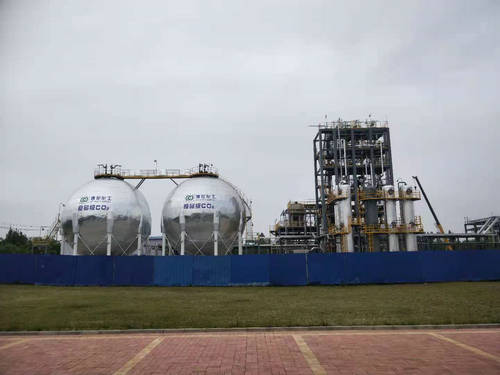
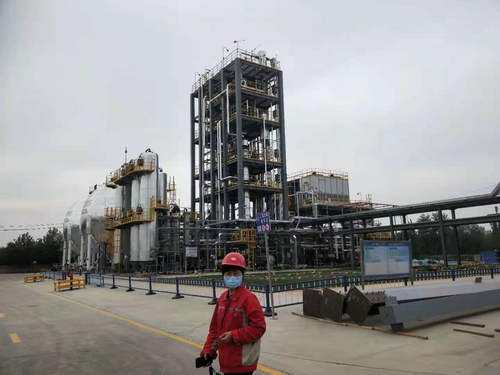
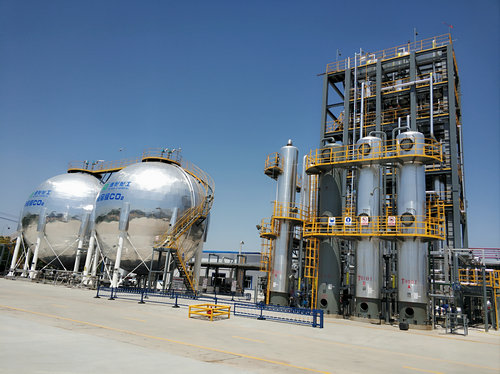
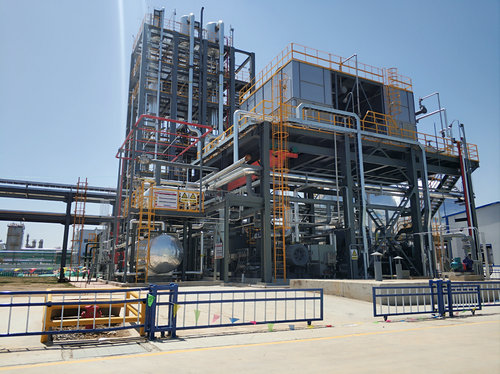
[Abstract] This article introduces the process flow and main equipment of a 200000 t/a food grade CO₂ recovery, liquefaction and purification unit, the current operation status and existing problems, and proposes rectification measures.
[Keywords] CO₂ recovery; Food grade CO₂; Purification; Liquefaction; Dehydrocarbon
1 Preface
Dezhou Dehua Chemical Co., Ltd. is a limited liability company established in 2002 to produce organic amine and alcohol products. Its current address is located in Dezhou Canal Hengsheng Chemical Industry Park, backed by Shandong Hualu Hengsheng Chemical Co., Ltd. Hengsheng Chemical Industry Park has a wide variety of products, and the production facilities are closely related. In terms of environmental protection management and facility operation, they complement each other, rely on each other, and constrain each other.
At present, some low-temperature methanol washing CO₂ feed gas and CO₂ tail gas are directly discharged from the Hualu Hengsheng ammonia alcohol workshop. In order to meet the requirements of energy conservation, emission reduction, and the development of circular economy, this project recovers 200000 tons of CO₂ for purification and liquefaction, turning waste into treasure, and having a positive impact on the atmospheric environment, as well as on the economic and social effects.
Selection of Process Scheme 2
Based on the characteristics of the raw gas and considering factors such as system operation safety, product energy consumption, product quality, and technical reliability, after multiple investigations and demonstrations, it has been decided to adopt the patented and proprietary new process of Hangzhou Kuaikai High Efficiency Energy saving New Technology Co., Ltd.: precision desulfurization, catalytic dehydrogenation, and low-temperature distillation combination method. The process is designed to prepare high-purity liquid CO₂, which has a thorough purification and produces liquid CO₂ products with a concentration of over 99.99% and stability. All indicators can meet or exceed the national food safety standard (food additive CO₂ standard) (GB1886.228-2016). There are two types of gas sources for this project. The purity of CO₂ raw gas can reach over 97%, the system pressure is 2.5MPA, the concentration of CO₂ tail gas raw gas is about 83%, and the system pressure is 3.5MPa (both raw gases are compressed high-pressure gases). For the two different gas sources, this project has undergone dual design, and the process flow and equipment selection can meet the production needs of both gas sources.
3 Process flow
The Hualu Hengsheng Ammonia Alcohol Workshop adopts low-temperature methanol washing technology. After supplying urea and dimethyl carbonate units with purified gas, there is still 20000 standard cubic meters of CO₂ waste gas remaining, with a purity of ≥ 97%, a pressure of 2.5MPa, and a purified tail gas purity of about 83%. The gas source is sufficient, and purified tail gas can be used when the purified gas is insufficient. This device recovers the remaining exhaust gas, with flexible process design. It can switch between industrial grade and food grade CO₂, and can switch between purified gas and purified exhaust gas.
Table 3.1 Gas composition of two types of feed gases
|
|
H2
|
O2
|
N2
|
CO
|
CH4
|
CO₂
|
H2S+COS
|
CH3OH
|
|
unit
|
V%
|
V%
|
V%
|
V%
|
V%
|
V%
|
ppm
|
ppm
|
|
purified gas
|
0.52
|
0.01
|
0.19
|
0.55
|
0.08
|
98.6
|
0.99
|
0.07
|
255
|
|
Purification of exhaust gas
|
0.4
|
0.18
|
15.86
|
0.46
|
0.01
|
83.08
|
0.22
|
0.82
|
35
|
Feed gas with a purity of approximately 83% and a pressure of 3.5 MPa enters the hydrolysis tower and the desulfurization tower. After organic sulfur and hydrogen sulfide are removed, the gas is preheated in the hydrocarbon removal preheater and then sent to the hydrocarbon removal purification tower, where the combustible components in the feed gas are converted into H₂O and CO₂ under the action of a catalyst. The high-temperature feed gas exiting the dehydro purification tower passes through the dehydro preheater to recover waste heat, then proceeds to the dehydro water cooler for cooling. Afterwards, it passes through the dehydro separator to separate condensed water, and then enters the dryer where it is further dried and dehydrated to <20 ppm using mixed molecular sieves. The dried, clean feed gas is further pre-cooled in aftercoolers A/B (which recover low-temperature non-condensable gases and off-gas residual heat) before entering the primary distillation system (comprising a primary purification column, primary condenser, and primary reflux tank) for primary liquefaction and distillation (primary refrigeration). Qualified food-grade liquid CO₂ is withdrawn from the bottom of the primary purification column, The non-condensable gases discharged from the first-stage reflux tank enter the second-stage condenser for further liquefaction, then proceed to the second-stage distillation system (including second-stage refrigeration and third-stage deep cooling, comprising a second-stage purification column, a third-stage condenser, and a second-stage reflux tank) for further deep-cooling liquefaction and distillation to remove non-condensable impurities from the feedstock. Qualified food-grade liquid carbon dioxide is obtained from the bottom of the second-stage purification column; The liquid CO₂ collected from the bottoms of the primary and secondary purification columns is cooled to -25°C in a subcooler before being sent to cryogenic storage tanks for storage and sale; the low-temperature non-condensable gas discharged from the secondary reflux tank first passes through a residual heat recovery unit to recover residual heat; the non-condensable tail gas after residual heat recovery is vented to a high-altitude vent or used as a source of regeneration and cooling air for the dryer.
The general process flow for feed gas with a purity of ≥97% and a pressure of 2.5 MPa is largely the same as described above, with two process improvements: First, due to its very low organic sulfur content, an integrated fine desulfurization agent is used, which can simultaneously remove both organic sulfur and hydrogen sulfide; second, because of its high purity and low impurity levels, a two-stage refrigeration system is sufficient to produce qualified food-grade carbon dioxide, eliminating the need for the CO₂ chiller and the third-stage deep-cold unit.
Hydrolysis desulfurization reaction: H2O + COS→H2S+CO₂
Fine desulfurization reaction: H2S +0.5 O2→H2O+S
Dehydrogenation catalytic reaction:
H2 + 0.5 O2→H2O
CO + 0.5 O2 →CO₂
CH4 + 2 O2 →CO₂+ 2 H2O
CH4O+ 1.5 O2→ CO₂+ 2 H2O
4 Refrigeration System Process
This project adopts three-stage refrigeration, namely first stage (refrigeration temperature -18 ℃) and second stage (refrigeration temperature -27 ℃) using ammonia refrigeration, and third stage deep cooling (refrigeration temperature -45 ℃) using R744 cascade refrigeration technology. The medium temperature refrigerant for cascade refrigeration is ammonia, and the low-temperature refrigerant is CO₂. According to the concentration of the raw gas, two-stage refrigeration and three-stage refrigeration are used respectively. This device is equipped with three sets of refrigeration units, namely two ammonia refrigeration units and one CO₂ refrigeration unit, and is equipped with ammonia storage tanks, auxiliary ammonia storage tanks, evaporative condensers, refrigerant liquefiers, condensing evaporators, etc. The cooling capacity required for the liquefaction and purification of CO₂ gas is provided by the evaporation and heat absorption of ammonia and CO₂ refrigerants. The supplementary ammonia for the system comes from the Hualu Hengsheng synthetic ammonia unit, and the supplementary CO₂ comes from the product of this unit.
5 Equipment selection
The main equipment of this device includes purification and purification equipment, catalysts, and refrigeration units. The purification equipment and catalysts are provided by Hangzhou Kuaikai High Efficiency Energy saving New Technology Co., Ltd. They have the characteristics of low consumption and large operating space. The refrigeration unit is selected as a complete set of equipment with mature technology and high degree of automation. The main equipment for food grade CO₂ is shown in Table 5.1.
Table 5.1 List of Process Equipment
|
serial number
|
serial number
|
Specification Model
|
material
|
quantity
|
|
1
|
Dehydrogenation purification tower
|
Ф1200
|
S30408
|
1
|
|
2
|
Hydrolysis tower
|
Ф1400
|
Q345R
|
2
|
|
3
|
Fine desulfurization tower
|
Ф1400
|
Q345R
|
1
|
|
4
|
dryer
|
Ф1200
|
Q345R
|
2
|
|
5
|
Primary purification tower
|
Ф800
|
16MnDR
|
1
|
|
6
|
Secondary purification tower
|
Ф800
|
S30408
|
1
|
|
7
|
Primary reflux tank
|
Ф800
|
16MnDR
|
1
|
|
8
|
Secondary reflux tank
|
Ф800
|
S30408
|
1
|
|
9
|
Dehydrogenation separator
|
Ф800
|
S30408
|
1
|
|
10
|
Desulfurization water cooler
|
Ф600
|
S30408/ Q345R
|
1
|
|
11
|
Dehydrogenation preheater
|
Ф800
|
Q345R
|
1
|
|
12
|
Dehydrogenation water cooler
|
Ф800
|
S30408/ Q345R
|
1
|
|
13
|
Residual cooling recycler A
|
Ф600
|
S30408/ Q345R
|
1
|
|
14
|
Residual cooling recycler B
|
Ф600
|
S30408
|
1
|
|
15
|
Primary condenser
|
Ф1000
|
铝合金
|
1
|
|
16
|
Secondary condenser
|
Ф1000
|
铝合金
|
1
|
|
17
|
Third stage condenser
|
Ф1000
|
铝合金
|
1
|
|
18
|
Subcooler
|
Ф500/800
|
Q345E/16MnDR
|
1
|
|
19
|
economizer
|
Ф800
|
铝合金
|
1
|
|
20
|
First stage reboiler
|
Ф500
|
Q345E/16MnDR
|
1
|
|
21
|
Secondary reboiler
|
Ф500
|
S30408
|
1
|
|
22
|
Refrigerant liquefier
|
|
Q345E/16MnDR
|
1
|
|
23
|
R744 storage tank
|
|
16MnDR
|
1
|
|
24
|
Refrigeration Unit A
|
Cooling capacity 1970Kw
|
|
1
|
|
25
|
Refrigeration Unit B
|
Cooling capacity 685Kw
|
|
1
|
|
26
|
Refrigeration Unit C
|
Cooling capacity 275Kw
|
|
1
|
|
27
|
CO₂low-temperature storage tank
|
1000m³/unit
|
16MnDR
|
2
|
6 Operation Status
This device was introduced with liquid ammonia on May 5, 2021, and feed gas on May 6. After half a day of operation, the moisture content and volatile residue of the industrial grade liquid CO₂ product gradually qualified, with a purity of 99.97%. After confirming the stable operation of the device, it meets the conditions for food grade start-up. On May 7, the catalytic dehydrogenation system began to heat up and activate, continuously heating up and activating to 400-410 ℃. The total hydrocarbons and benzene at the outlet of the dehydrogenation tower were not detected, and the dehydrogenation system was officially put into use after activation and heating up. The device runs smoothly. The product purity (>99.99%), total hydrocarbons, total sulfur, aromatic hydrocarbons, methanol and other indicators all meet food grade standards.
7 Problems and Technical Improvement Measures
Due to the fact that the raw gas comes from Hualu Hengsheng and is far away from the gas source outlet, the gas outlet temperature is 45-60 ℃, and the pipeline is not insulated. The temperature of the raw gas basically changes with the temperature. The optimal temperature for hydrolysis desulfurization is between 30-60 ℃, and the optimal temperature for fine desulfurization is 5-30 ℃. In winter, the desulfurization effect may be poor due to the low temperature of the raw gas. It is necessary to increase pipeline insulation or heat exchangers to ensure the temperature of the raw gas. The heat source of the heat exchanger can use the surplus steam or steam condensate in the park to adjust the temperature of the raw gas in a timely manner to ensure the desulfurization effect.
8 Conclusion
This food grade CO₂ device adopts advanced and innovative production processes. It switches the process flow for two different concentrations of raw gas, and scientifically and reasonably selects suitable and efficient desulfurizers and dehydrocarbon catalysts based on the characteristics of the raw gas. The product purity can reach 99.99%. And this device has the characteristics of low design energy consumption, high degree of automation, and stable operation, which can effectively reduce production costs and personnel input.
The recycling and utilization of CO₂ waste gas generated by low-temperature methanol washing has reduced greenhouse gas emissions. The construction of this project complies with the requirements of China's 13th Five Year Plan for National Economic and Social Development, national industrial policies, and is an energy-saving and environmental protection project for low-carbon economy and comprehensive resource utilization. At the same time, it has improved the economic and social benefits of the enterprise and made contributions to China's carbon peak, carbon neutrality, and emission reduction undertakings.